




Table of Contents
Moving to Germany from another EU country is legally straightforward, but administratively demanding. EU freedom of movement means you can enter Germany and start building your life there without a visa. In practice, Germany expects you to register your address quickly, prove you have health insurance, and handle several systems (housing, tax, social security) that are tightly connected to paperwork and local appointments.
This guide focuses on long-term relocation (months to years), not commuting or short stays. It explains what EU citizens need to do, how the rental process works, and where people get stuck so you can plan your move with fewer surprises.
EU freedom of movement vs. Germany’s “you must register” reality
If you’re an EU citizen, you can enter Germany with a valid passport or national ID card, and you do not need a residence permit to live and work there.
What often confuses new arrivals is that Germany still requires administrative formalities, especially address registration (Anmeldung). Registration is not a visa process. It is how Germany records who lives where, and many practical steps depend on it (tax ID, contracts, school registration, etc.). German law requires anyone moving into a residence to register within a set timeframe.
So, is it “easy”?
- Easy to enter and start the move (legal right to move and work).
- Harder to settle (housing competition, registration appointments, German-language bureaucracy).
What’s required to relocate: the core checklist
For an EU citizen moving to Germany for the long term, the key requirements are:
- Valid ID document (passport or national ID card) for entry and most admin steps.
- A German address + Anmeldung (address registration at the local registration office).
- Landlord confirmation (Wohnungsgeberbestätigung) to complete Anmeldung.
- Health insurance (Germany requires residents to be insured).
- Employment and payroll setup (if working): tax ID, social security number processes, and choosing a health insurer (statutory/private, depending on your situation).
Do EU citizens need a residence permit?
No. EU citizens entitled to freedom of movement do not need a visa or residence permit to enter or stay in Germany.
What changes after 3 months in Germany?
EU-level guidance is clear that during the first three months, you generally can’t be required to obtain a residence document confirming your right to live in the country, though some countries require presence/registration formalities.
For longer stays, the right of residence depends on your status (worker, self-employed, student, jobseeker, economically inactive with sufficient resources and comprehensive health insurance).
In Germany, authorities can ask you to substantiate that you meet the conditions for exercising free movement rights after a stay of more than three months (for example, as a jobseeker, you may have to declare that you are seeking work).
What about non‑EU nationals who currently live in the EU?
If you are not an EU/EEA/Swiss citizen, being physically “within the EU” does not automatically give you EU free-movement rights. You’ll typically need to follow Germany’s rules for third-country nationals (visa/residence title depending on nationality and purpose). Start with official guidance from Germany’s Federal Employment Agency (“Which visa do I need?”) and the EU’s immigration portal for Germany.
What about non‑EU family members of an EU citizen?
Non‑EU family members can have derived rights under EU free movement rules, but they often need a residence card as documentation. For example, after five years of legal residence, non‑EU family members can receive a permanent residence card within a stated processing timeframe once they apply.
Anmeldung: Germany’s central admin step (and the #1 bottleneck)
Anmeldung is the formal registration of your address at the local registration authority (often called Bürgeramt, Bürgerbüro, or Einwohnermeldeamt). Germany’s Federal Registration Act requires people moving into a residence to register within two weeks.
Why Anmeldung matters
Anmeldung is a gateway to many essential processes, including:
- receiving/confirming your tax identification number
- signing certain contracts
- accessing some public services
What you need for Anmeldung
Exact requirements vary slightly by city, but commonly you need:
- Valid passport or EU ID card
- Completed registration form (from your city/municipality)
- Wohnungsgeberbestätigung (landlord confirmation)
Important: A rental contract alone is often not accepted as a substitute for the landlord confirmation.
Wunderflats has a dedicated explainer on the confirmation of residence document and why it matters for Anmeldung: useful when you’re booking temporary housing and need to know whether registration support is possible.
Registration delays: what to expect
In many cities, getting an appointment can take time. The legal deadline remains, but in practice, municipalities often focus on whether you booked the earliest possible appointment and have evidence you tried to comply.
A practical detail from Germany’s federal service portal: for certain registration procedures, making a timely appointment can be treated as sufficient to meet the deadline (the portal notes that timely agreement of an appointment is sufficient).
Can you register online?
Digital options exist, but they are not uniform across Germany. For example, Bavaria’s portal indicates online registration can be available for German nationals and EU citizens who can identify themselves with an eID (via BayernID/BundID), while coverage differs for other groups.
Treat online Anmeldung as a bonus option, not your baseline plan.
Moving within Germany later
If you relocate from one German city to another, you generally register at your new address and the previous municipality is informed automatically.
Health insurance: compulsory, and tied to your long-term setup
Germany requires residents to have health insurance coverage. This is not optional, and it affects employment, university enrollment, and sometimes residence-related checks.
EHIC vs long-term coverage
If you arrive with a European Health Insurance Card (EHIC), it can help for temporary stays. For a long-term move, you usually need stable coverage within Germany, especially if you establish residence, start working, or become a jobseeker based in Germany.
Germany’s EU equal treatment office highlights practical scenarios for EU citizens (employees, jobseekers, family members) and emphasizes that once you establish residence and stay beyond short periods, you must ensure proper coverage; it also notes that if you stay longer than three months, you are subject to local registration obligations.
Statutory vs private health insurance
Germany has a dual system:
- Statutory health insurance (GKV): common for employees (and many other categories).
- Private health insurance (PKV): possible under certain conditions.
If you are employed in Germany, you should arrange membership with a health insurance provider before you start work, because your employer needs your insurance details for payroll and social security reporting.
Housing search in Germany: the practical hurdle behind “easy relocation”
Legally, you can move to Germany quickly. Practically, you can’t complete the core admin steps without an address you can register.
Expect competition in many regions
In many metropolitan areas and university towns, affordable housing is scarce. Germany’s federal building and spatial planning institute has explicitly pointed to missing affordable housing in agglomerations and the need to relieve strained housing markets.
That reality shapes everything:
- viewings are competitive
- landlords choose tenants based on documentation
- temporary accommodation often becomes a strategic step, not a luxury
Furnished vs unfurnished: know what you’re signing up for
- Unfurnished long-term rentals often mean you bring or buy a kitchen, lights, and sometimes more.
- Furnished rentals (including temporary housing) can let you land first, register, and then search for a longer-term place with less pressure.
For EU movers, the key question is whether the accommodation supports what you must do next: Anmeldung and paperwork.
Documents landlords commonly request
Even when not legally mandatory, these are standard in many cities:
- proof of income (payslips or employment contract)
- Schufa credit report (or alternative proof if new to Germany)
- passport/ID copy
- rental self-disclosure form (Selbstauskunft)
- sometimes a confirmation of no rental debt (Mietschuldenfreiheitsbescheinigung)
If you’re relocating from within the EU, prepare substitutes for anything Germany-specific:
- if no Schufa yet, offer bank statements, proof of savings, or an employer letter
- show a stable contract length and probation period details
Deposits (Kaution): the legal ceiling
For most residential leases, the deposit is capped by law at three months of rent (excluding operating costs).
If the security is paid as a money sum, the tenant is also entitled to pay it in three equal monthly installments, starting at the beginning of the tenancy.
These rules matter when you compare offers. If a landlord demands more than the legal maximum for a standard residential lease, that’s a red flag.
Notice periods: planning your exit matters
A standard open-ended residential contract typically allows ordinary termination with a notice schedule set out in the Civil Code (commonly understood as a “three-month” structure when applying the statutory timing rule).
If you’re using a temporary place first, confirm:
- minimum rental term
- extension rules
- notice clause
- whether the contract is explicitly “temporary use” and what that means for termination
Tenant rights and “handover” discipline
Germany’s rental system is document-driven. Protect yourself by insisting on:
- a written contract
- a handover protocol (Übergabeprotokoll) noting the apartment condition and meter readings
- clarity on what utilities are included, what you pay separately, and how bills are settled
Employment in Germany: simple access, structured setup
Do EU citizens need a work permit?
No. EU citizens can work in Germany under freedom of movement rules.
What you do need is a clean administrative path so you can be paid correctly and stay compliant.
Tax: your tax ID is foundational
Germany uses a tax identification number for individuals. Official guidance via Germany’s federal service portal indicates that residents receive a tax identification number automatically.
A German tax office site also explains that for individuals living in Germany, issuance happens automatically when registration authorities transmit registration data to the Federal Central Tax Office.
Practical implication: Anmeldung is often the trigger that makes the rest of your payroll setup smoother.
Social security: your insurance number is tied to work
Germany’s pension insurance institution explains that the insurance number is normally assigned when a person first starts work and does not change.
Deutsche Rentenversicherung’s FAQ content also describes that when your employment is reported (often via your health insurer as a collection agency), that can trigger assignment of the insurance number by the responsible pension insurance institution.
For most employees, the employer and payroll provider handle the reporting; your job is to provide correct personal data and make sure your health insurance membership is set up in time.
Recognition of qualifications: only mandatory for regulated professions
Many jobs in Germany are not regulated. Some are, and in those cases you may need recognition before you can practice (healthcare professions are a common example).
The federal “Recognition in Germany” portal explains that recognition means your foreign qualification is assessed for equivalence to the German one, and regulated professions can require additional authorization criteria.
Germany’s Federal Employment Agency also notes that if your profession is regulated, you must have your foreign qualification recognized.
If you’re moving from within the EU and want to work in your trained profession, check recognition early: before you sign a lease based on an assumed start date.

Bureaucracy in Germany vs. other EU countries: where the friction comes from
EU movers often expect the hardest part to be “permission to stay.” In Germany, permission is rarely the issue for EU citizens. The friction usually comes from process design:
- Local administration (federal structure)
Many tasks are municipal. Rules are national, but implementation and appointment availability are local. - Paperwork dependencies
Anmeldung depends on a landlord’s confirmation. Tax ID depends on registration data flows. Employment depends on having health insurance and correct personal details. - Appointments are a resource
A process can be legally simple but practically slow if appointments are limited. - Digital services exist, but coverage is uneven
Some states/cities offer online registration for EU citizens with eID, but it is not nationwide.
Compared with EU countries that centralize resident admin through one national system or provide broader digital services, Germany can feel fragmented. That doesn’t stop you from moving—it changes how you should plan.
Common challenges EU citizens face when relocating to Germany
1) Housing shortage and competition
In many major regions, demand exceeds supply, especially for affordable rentals. Federal research has explicitly described strained housing markets in dynamic agglomerations and university towns.
Impact: you may need temporary housing while you search.
2) Language barriers in admin and rentals
Many landlords and offices operate primarily in German. Even when staff speak English, forms and legal documents are often in German.
Impact: misunderstandings about contract terms, notice periods, included costs, and required documents.
3) Registration delays
Even if the law expects registration within two weeks, appointments may not align with that expectation.
Impact: knock-on delays (tax letters, banking, some employer onboarding steps).
4) Confusion between “Anmeldung” and “residence permit”
EU citizens don’t need a residence permit, but they do need registration—and after longer stays, they may need to be able to show they meet freedom-of-movement conditions if asked.
5) Moving with non‑EU family members
Non‑EU family members often need residence documentation and timelines can differ from what EU citizens expect.
Tips to make moving to Germany from the EU easier
Prepare before you arrive: the document pack
Bring (paper + digital copies):
- passport or national ID card
- birth certificate (useful for family-related admin)
- marriage certificate / registered partnership documents (if applicable)
- employment contract or proof of income/savings
- university enrollment letter (if you’re a student)
- proof of health insurance coverage (and plan for German coverage if staying)
- prior address documents (sometimes requested by banks/employers)
- a set of passport-style photos (occasionally helpful)
If your documents are not in German or English, consider certified translations, especially for regulated professions or family processes.
Plan around the address-registration dependency
Because Anmeldung requires a landlord confirmation, you should prioritize housing that allows legitimate registration.
If you use interim accommodation, confirm early:
- Is Anmeldung allowed at this address?
- Will the landlord provide a Wohnungsgeberbestätigung?
- When will you receive it?
Wunderflats’ guidance on the confirmation of residence document can help you understand what to ask for and why it’s required.
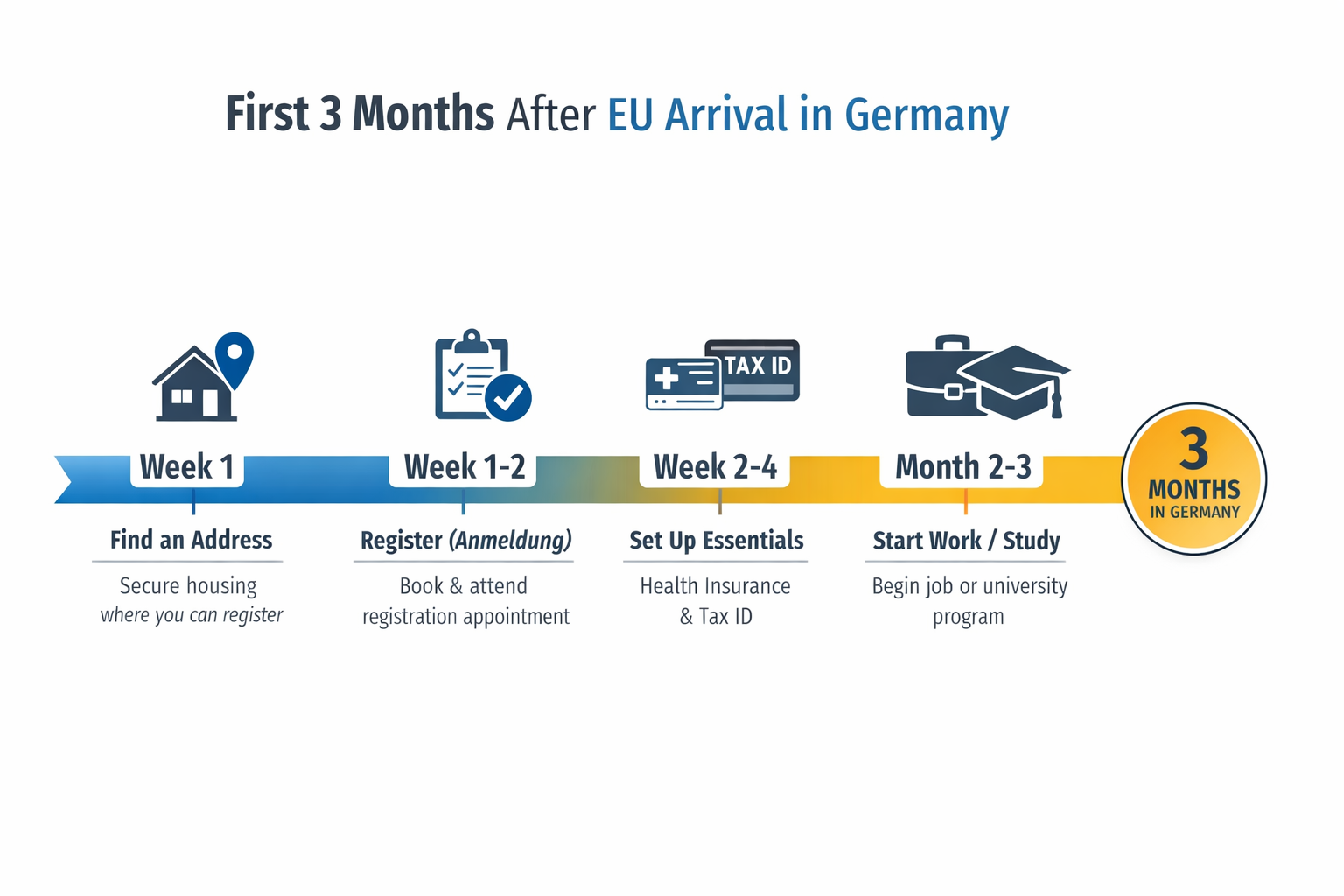
Time your first month with a simple sequence
A workable order for most EU citizens:
- Secure an address you can register
- Book Anmeldung appointment immediately (even before you arrive if possible)
- Complete Anmeldung and keep the registration confirmation
- Set up health insurance (or confirm statutory coverage via employer)
- Start work / finalize payroll (tax ID, social security reporting)
- If needed: recognition procedure for regulated professions
- Then optimize (longer-term apartment, daycare/school, car registration if relevant)
Use temporary housing strategically
For long-term relocation, interim accommodation is often the difference between:
- searching for housing from abroad under time pressure, and
- searching locally with documents, viewings, and flexibility.
This is where furnished mid-term rentals can help EU movers: you get a stable base, and you can schedule appointments and viewings efficiently. The key is ensuring the accommodation supports legal registration.
Don’t ignore the “permanent residence” milestone
After five years of lawful residence, EU citizens can acquire a permanent right of residence and can request certification of it.
This matters if you plan to stay long-term and want clear proof for employers, banks, or future family processes.
Easy entry, real-life hurdles
Moving to Germany from within the EU is easy in the way that matters most: you can legally go, live, and work there without a visa or residence permit.
What is not easy is the settling-in layer: finding housing in competitive markets, registering your address quickly, setting up health insurance correctly, and aligning tax and social security paperwork with your start date. Germany is process-driven and local-appointment-driven. If you plan your move around the Anmeldung requirement and the housing reality, the relocation becomes manageable.